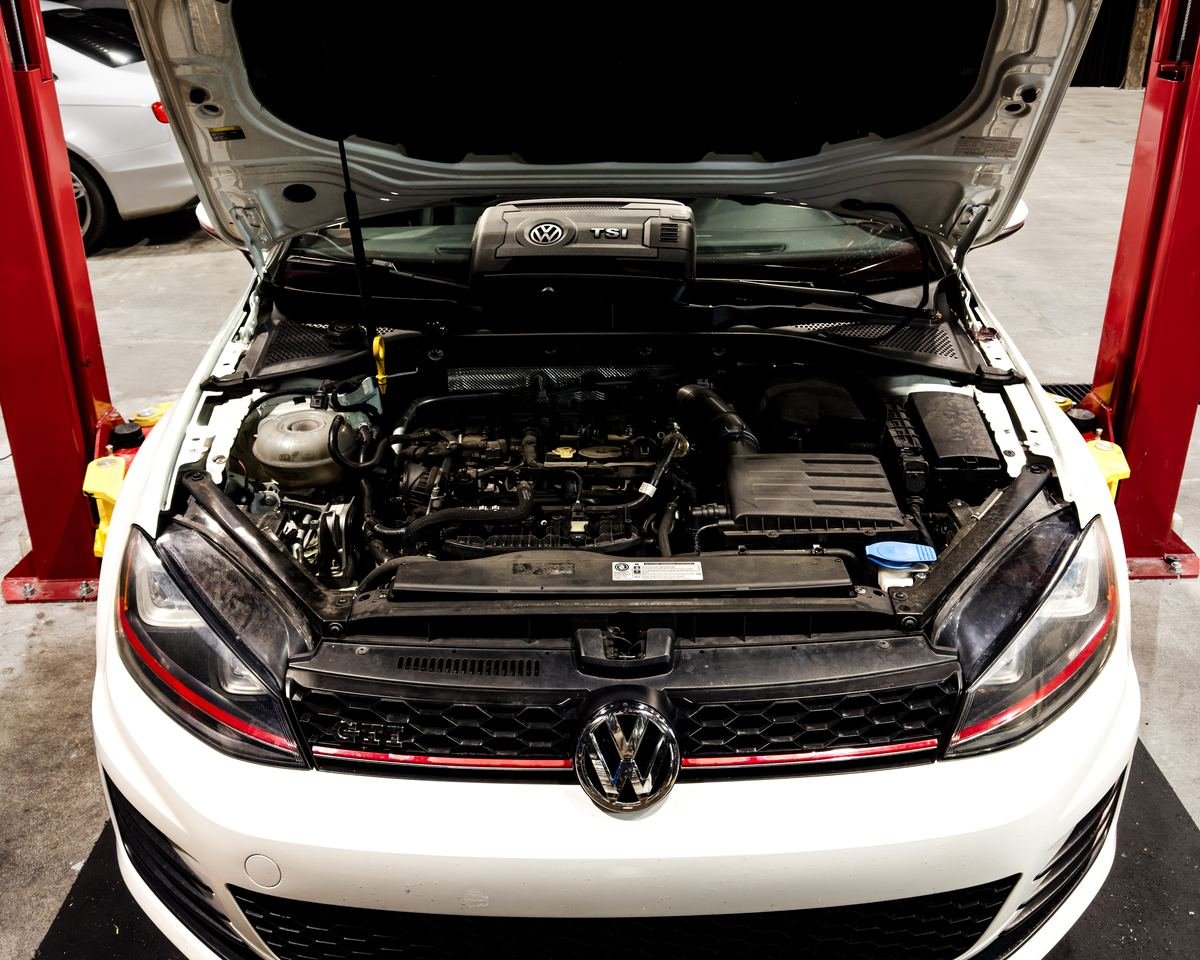
If you drive a turbocharged Audi or Volkswagen around Lexington, there's a good chance it has a direct-injection engine. These engines make strong power and good fuel economy, but they share a well-known trait: carbon slowly builds up on the intake valves. As the mornings cool off this fall, a rough cold start is often the first hint that something is going on. Here's what carbon buildup is, why it happens, what it feels like from the driver's seat, and what can be done about it.
What is carbon buildup on a direct-injection engine?
In an older port-injected engine, fuel sprays into the intake port just behind the intake valve. That fuel constantly washes over the back of the valve and helps keep it clean.
A direct-injection engine sprays fuel straight into the combustion chamber instead. VW and Audi badge many of these engines as FSI, TFSI or TSI. Putting fuel directly into the cylinder has real benefits, but it means nothing is washing the intake valves anymore. Over time, a hard, dark crust of carbon can form on the backs of the valves and in the intake ports. That crust disrupts airflow into the cylinder, and the engine starts to run less smoothly.
Why do Audi and VW engines get carbon buildup?
Every engine pushes a little oil vapor out of the crankcase. The crankcase ventilation system, often called the PCV system, routes that vapor back into the intake so it gets burned instead of vented into the air. On a direct-injection engine, some of that oily vapor sticks to the hot intake valves and bakes on. Layer by layer, it turns into carbon.
A few things tend to speed it up:
- Lots of short trips. An engine that rarely gets fully warm builds up more moisture and oil vapor.
- A failing PCV valve or oil separator. When it stops doing its job, more oil ends up in the intake.
- Stretched oil changes. Oil that's past its life, or that doesn't meet the factory spec, can break down and add to the vapor going into the intake.
- Mileage. Buildup is gradual, so higher-mileage cars are more likely to have it.
Some newer VW and Audi engines pair direct injection with a second set of port injectors, which puts fuel back on the valves part of the time and helps keep them cleaner. Whether your engine has that setup varies by model and year.
What are the symptoms of carbon buildup?
Because carbon builds slowly, many owners don't notice it until it's fairly heavy. Common signs include:
- A rough or shaky idle, especially right after a cold start
- Misfires, sometimes with a steady or flashing check engine light
- Hesitation or stumbling when you accelerate
- A gradual loss of power or throttle response
- Worse fuel economy than the car used to get
A flashing check engine light means the engine is misfiring badly enough to risk damaging the catalytic converter. If you see one, take it easy and have the car checked soon rather than driving it hard.
How is carbon buildup diagnosed?
Those symptoms can come from carbon, but they can also come from a worn ignition coil, old spark plugs, a sticking fuel injector, a vacuum leak or a failed PCV valve. Cleaning the valves won't fix a bad coil, so diagnosis comes first.
We start with ODIS, the dealership diagnostic tool for VW and Audi. It lets us read fault codes and watch live data, such as misfire counts by cylinder and fuel trims, to narrow down the cause. Kevin, one of our co-founders, holds Master Technician credentials from Volkswagen and Audi dealerships, so these engines are familiar ground. If the data points toward carbon, the next step is to look at the valves themselves. That way you know what you're dealing with before anything gets taken apart for cleaning.
How do you clean carbon off intake valves?
The usual method is walnut blasting. The intake manifold comes off, and the engine is turned so the valves on the cylinder being cleaned are closed. Finely crushed walnut shells are then blasted into the intake port while a vacuum pulls the loosened carbon and media back out. Walnut shell is hard enough to knock carbon loose but soft enough not to harm the metal underneath. Each cylinder gets the same treatment, and then the intake goes back on with new gaskets.
What about fuel system cleaners? On a direct-injection engine, fuel from the tank never touches the intake valves, so a bottle of additive in the gas tank can't reach the deposits. Spray-in intake cleaners are out there too, but heavy, baked-on carbon generally needs to be physically removed.
Can you prevent carbon buildup?
You can't stop it completely on an engine that relies on direct injection alone, but you can slow it down:
- Change the oil on time with a factory-approved oil. Fresh oil that meets the spec for your engine is one of the simplest things you can do. We use factory-approved oils for this reason.
- Get the engine fully warm. Regular drives long enough to bring the engine up to temperature help burn off moisture and vapor that short trips leave behind.
- Keep the PCV system healthy. A rough idle, a whistling sound from the engine bay, or rising oil consumption can point to a PCV problem. Fixing it early limits how much oil reaches the intake.
- Don't ignore early misfires. Catching a problem while it's small keeps the repair small.
Some owners also add an oil catch can to trap oil vapor before it reaches the intake. Results vary by engine and setup, so it's worth talking through with us before you buy one.
Carbon buildup help in Lexington
If your Audi or VW idles rough on cold mornings, has started to misfire, or just doesn't pull the way it used to, carbon buildup is worth ruling in or out. We diagnose and repair Audi and Volkswagen engines for owners across Lexington and Central Kentucky, and we'll walk you through what we find and what we recommend.
Call us at 859-407-2226 or book online. We're at 2029 Buck Lane in Lexington, open Monday through Friday, 8:00 AM to 5:00 PM.